
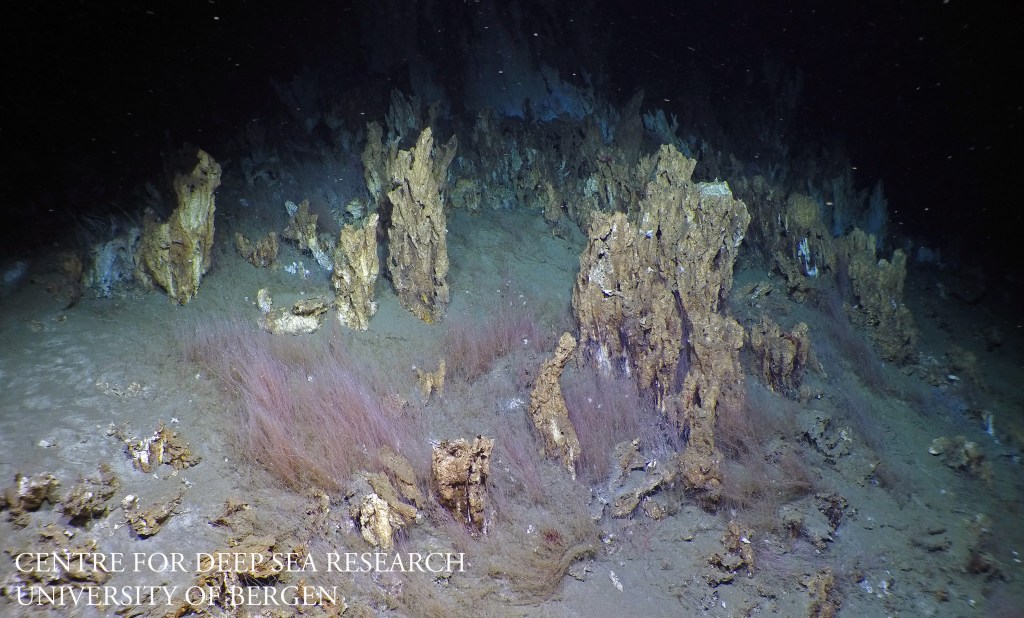
Image: Loki’s Castle vent field (2300 m).
CBE Arctic is a research team based at the Department of Biological Sciences at the University of Bergen in Norway. We are part of the Deep Sea Biology Research group and the multidiciplinary Centre for Deep Sea Research.
The research of the CBE Arctic team focuses on understanding the faunal communities of chemosynthesis-based ecosystems in the Arctic region. Chemosynthesis-based ecosystems (CBEs) is a term uniting various ecosystems in the deep-sea which have primary production by chemosynthesis: hydrothermal vents, cold seeps and organic falls.
Hydrothermal vents are areas where hot seawater enriched in reduced compounds, such as hydrogen sulphide, streams out of the seafloor. Dissolved minerals are deposited where the fluid streams out, forming chimney-like structures, and the fluid itself looks like smoke. Hydrothermal fluids can have temperatures of up to 350°C, and dissolved minerals are deposited where the smoke-like fluids stream out, forming hydrothermal chimneys. At cold seeps, hydrocarbon-rich fluids seep out of the seafloor at ambient seawater temperatures. Organic falls such as whale- or wood falls can also form CBEs, where the microbial breakdown of organic matter produces hydrogen sulphide, which can then be used for chemosynthesis.
The CBE Arctic team researches the diversity, ecology, biogeography, connectivity and evolutionary history of the fauna inhabiting CBEs. Some central research questions we focus on are:
- What is the connectivity between the faunal communities of the various CBEs in the Arctic region?
- What degree of geneflow is there between populations of CBE-specialized fauna?
- How does the fauna of Arctic CBEs relate to CBE-fauna in other ocean regions?
- How have the CBE-specialized species adapted to living in the extreme environmental conditions?
The work of CBE Arctic is mainly based on faunal samples collected by research cruises to the Arctic Mid-Ocean Ridges by the Centre for Deep Sea Research (previously Centre for Geobiology and KG Jebsen Centre for Deep Sea Research). Through collaboration with the Arctic University of Norway (UiT) within the AKMA and EXTREMES projects, we have collected samples from cold seeps at various depths on the continental shelf, slope and near the mid-ocean ridge. We also have access to samples from other research cruises in the region such as the GoNorth and HACON projects.
Selected papers from CBE Arctic
Eilertsen, M. H., Klemetsdal, M. L. B., Kongsrud, J. A., Tandberg, A. H. S., Alvestad, T., Esteban Vazquez, B. L., Savini, A., Argentino, C., & Panieri, G. (2025). Faunal Communities of Arctic Deep-Water Methane Seeps are Specialised with Links to Hydrothermal Vents. Deep Sea Research Part I: Oceanographic Research Papers, 255, 104594. https://doi.org/10.1016/j.dsr.2025.104594
Eilertsen, M. H., Kongsrud, J. A., Tandberg, A. H. S., Alvestad, T., Budaeva, N., Martell, L., et al. (2024). Diversity, habitat endemicity and trophic ecology of the fauna of Loki’s Castle vent field on the Arctic Mid-Ocean Ridge. Sci Rep 14, 103. doi: 10.1038/s41598-023-46434-z
Eilertsen, M. H., Dahlgren, T. G., and Rapp, H. T. (2020). A New Species of Osedax (Siboglinidae: Annelida) From Colonization Experiments in the Arctic Deep Sea. Frontiers in Marine Science 7, 443. doi: 10.3389/fmars.2020.00443
Eilertsen, M. H., Georgieva, M. N., Kongsrud, J. A., Linse, K., Wiklund, H., Glover, A. G., et al. (2018). Genetic connectivity from the Arctic to the Antarctic: Sclerolinum contortum and Nicomache lokii (Annelida) are both widespread in reducing environments. Scientific Reports 8, 4810. doi: 10.1038/s41598-018-23076-0
Eilertsen, M. H., Kongsrud, J. A., Alvestad, T., Stiller, J., Rouse, G. W., and Rapp, H. T. (2017). Do ampharetids take sedimented steps between vents and seeps? Phylogeny and habitat-use of Ampharetidae (Annelida, Terebelliformia) in chemosynthesis-based ecosystems. BMC Evolutionary Biology 17, 222. doi: 10.1186/s12862-017-1065-1
 cbearctic.com