
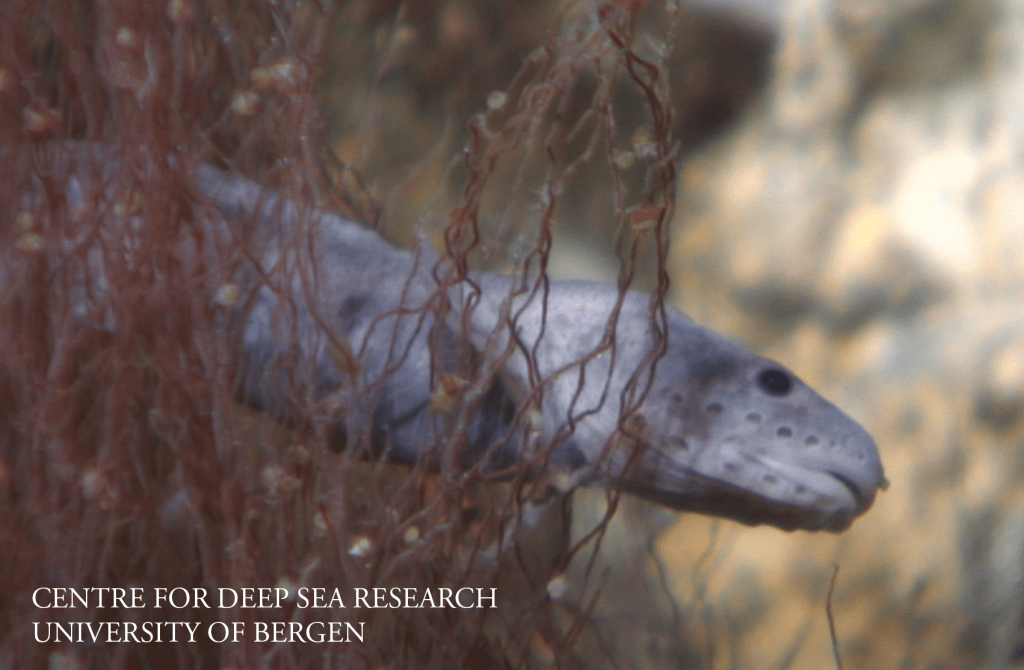
A new paper from the CBE Arctic Team and collaborators, led by Peter Møller from the Natural History Museum Denmark, University of Copenhagen, provides new information on a poorly known small Arctic eelpout
If you’ve watched ROV footage from the Arctic Mid-Ocean Ridge, you may have seen a small fish resting on chimneys and among tubeworms at hydrothermal vents and methane seeps. Although it is commonly observed, the identity and ecology of this fish have remained unclear until now.
Our new paper, published in Deep Sea Research Part I, confirms that the fish from the Arctic vents and seeps is the species previously known as Lycenchelys platyrhina. DNA analyses revealed that its closest relative is the Atlantic vent eelpout Pachycara thermophilum, and the species has therefore been moved to the genus Pachycara (Pachycara platyrhina comb. nov.).
We also hypothesize that P. platyrhina is attracted to hydrothermal vents and cold seeps by the abundant food there, such as gastropods and crustaceans. ROV footage also suggests that it “basks” in the warm vent water, which could speed up embryonic or larval development or aid digestion. The species is not restricted to chemosynthesis-based ecosystems, though. It is also found away from vents and seeps, so it seems to tolerate a wide range of temperatures even if, as the paper title suggests, they “like it hot”.
This work is a result from the WormFEST project, which explores the worm forests at Arctic hydrothermal vents and cold seeps.
Read the paper: Møller, P.R., Straube, N., Lauridsen, H., Bergmann, M., Arthur Pedersen, H., Worsaae, K., Eilertsen, M.H. (2026). Some like it hot: The enigmatic Arctic deep-sea eelpout Pachycara platyrhina thrives at hydrothermal vents. Deep Sea Research Part I: Oceanographic Research Papers, 232, 104737. https://doi.org/10.1016/j.dsr.2026.104737


Leave a Reply